
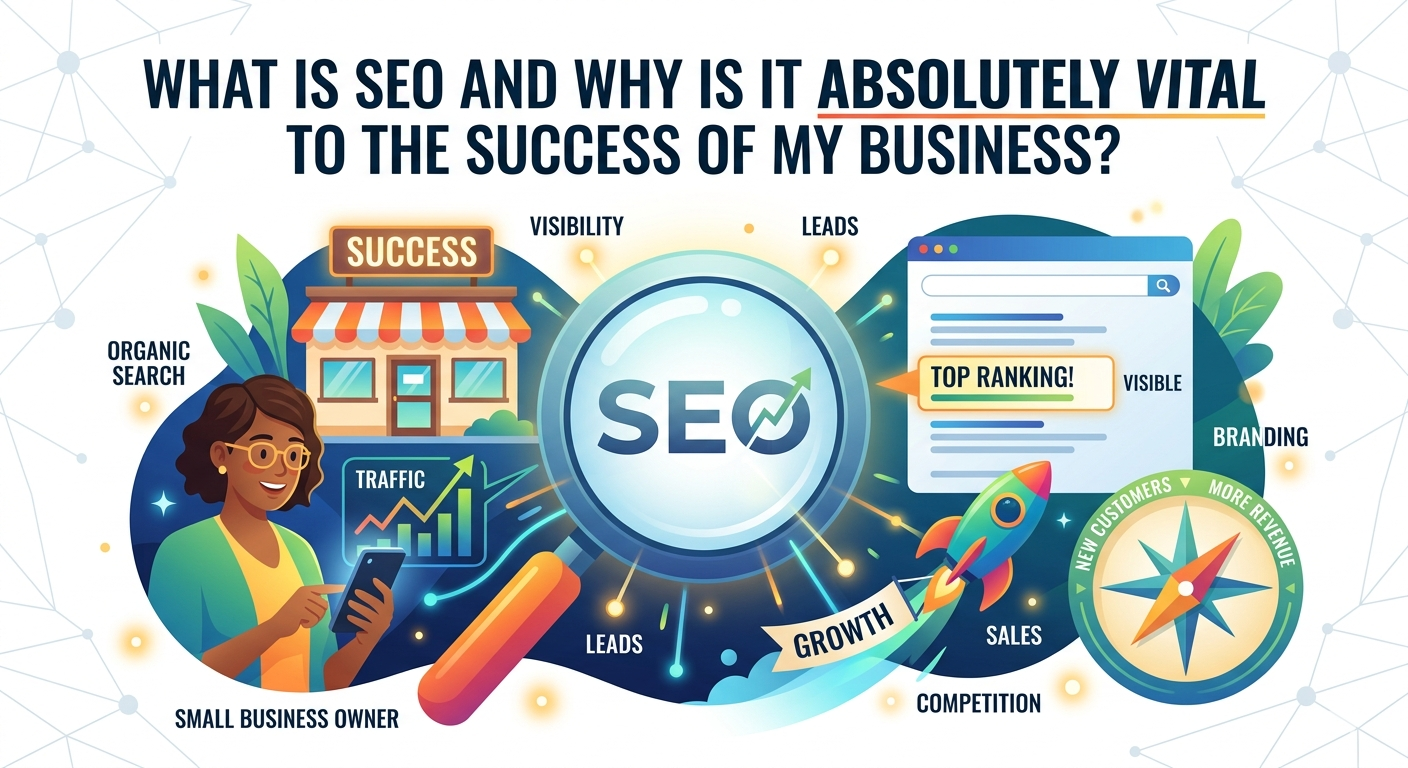
What is SEO and Why is it Absolutely Vital to the Success of my Business?
Introduction: The Silent Engine Behind Every Successful Online Business
In today’s digital landscape, where more than 4.9 billion people worldwide now access the internet, having a strong online presence isn’t optional—it’s essential. But while most businesses focus on flashy ads, social media posts, and paid campaigns, one fundamental pillar often goes underutilized: Search Engine Optimization, or SEO.
What is SEO? Why should it matter to your business? And most importantly—why is it absolutely vital to your success?
Whether you’re running a small local business, an e-commerce store, or a service-based company, this article will provide you with everything you need to understand. From the basics of what SEO actually means, to how it drives real business results like increased traffic, better leads, and higher revenues.
“SEO is not a sprint—it’s a marathon. But if you skip the foundation, you’ll never cross the finish line.”
What Is SEO?
SEO (Search Engine Optimization) is the practice of optimizing your website so that it ranks higher in search engines like Google, Bing, and Yahoo for relevant keywords. When someone searches for something online—whether they’re looking for “plumbers near me,” “best coffee shop downtown,” or “how to fix a leaky faucet”—you want your business to appear at the top of the results.
Search engines use complex algorithms to determine which websites are most relevant and authoritative for a given query. SEO helps you align with those algorithms so that search engines understand:
- What your website is about
- Who your target audience is
- Why visitors should choose you
The Three Pillars of SEO
SEO works on three main pillars:
- Technical SEO—Ensuring your website is technically sound. This includes fast page load speeds, mobile-friendliness, secure HTTPS connections, proper site structure, and clean code.
- On-Page SEO—Optimizing individual web pages for specific search queries. This involves crafting relevant content, using the right keywords naturally, writing strong titles and meta descriptions, optimizing images, and creating internal links to guide search engines through your site.
- Off-Page SEO—Building your website’s authority through external signals. This includes earning high-quality backlinks from other reputable websites, generating positive reviews on platforms like Google Business Profile, and fostering social proof that signals to search engines you’re trusted and credible.
Think of it this way: Technical SEO is like building a sturdy foundation for your house. On-Page SEO is putting up attractive features—like windows and doors—that let people see inside. Off-Page SEO is like neighbors recommending your home to their friends, which convinces strangers to visit.
Why SEO Is Absolutely Vital to Your Business
In 2026, with over 5.5 billion people globally online and hundreds of billions of monthly searches across search engines, SEO is the gateway to your customers. Let’s break down why ignoring it can be detrimental—and why getting it right can transform your business.
1. SEO Drives Consistent, High-Value Traffic
Paid ads (like Google Ads or Facebook Ads) are powerful—but they stop working the moment you stop paying them. SEO delivers something far more valuable: organic traffic.
Imagine this scenario:
| Metric | Paid Ads | SEO (Organic) |
|---|---|---|
| Cost Per Click | $0.50 – $5.00+ | $0.00 (free after optimization) |
| Lifetime Value | Campaign ends = traffic stops | Continuous, compounding over months/years |
| User Intent | Mixed (some casual browsing) | High intent—they’re searching for exactly what you offer |
| Click-Through Rate | 10–20% for top positions | 20–35% (top 3 positions capture 67.6% of clicks) |
The takeaway? SEO traffic is free, sustainable, and highly targeted. It compounds over time—you invest effort upfront, and the results keep growing.
2. SEO Builds Trust and Credibility
Your website’s ranking acts as a social endorsement from Google itself. Users trust top-ranked sites more. In fact:
- 93% of users say they trust search engine results.
- 75% of searches go to the top three results.
- 67% of consumers only click on one link—and that’s typically number one.
Ranking #1 for key phrases doesn’t just drive clicks—it signals authority and trustworthiness. It tells your customers, “We’re the leaders in this space.”
3. SEO Outperforms Social Media Long-Term
Social media platforms like Facebook, Instagram, and TikTok are valuable—but their algorithms constantly change. What worked yesterday may not work tomorrow. Plus, organic reach on social is declining.
SEO, by contrast, builds equity in search engines that can’t be revoked overnight. It’s your business’s most valuable long-term asset.
4. SEO Fuels All Other Marketing Channels
Great SEO content helps:
- Email marketing: Capture leads via blog signup forms
- Social media: Share high-performing posts to attract followers
- Paid ads: Retarget engaged visitors with higher conversion rates
- Voice search: Optimize for questions like “Best coffee shops near me”
- Local SEO: Dominate “near me” searches that bring in local foot traffic
Your website becomes the central hub that amplifies every marketing effort.
5. SEO Delivers Higher ROI Than Paid Advertising
According to a HubSpot study, SEO generates over 54x more leads than traditional paid advertising. Why?
- Lifetime value: An article you publish once can rank for years.
- Targeted traffic: People searching actively have higher intent.
- Compounding effect: Each new page, link, and update strengthens your overall authority.
The Hidden Costs of Ignoring SEO
Many businesses underestimate the impact of skipping SEO. But here’s what happens when you leave search engines on the sidelines:
1. You Become Invisible to New Customers
If a customer searches for your product or service, you won’t appear unless they guess your exact URL or find you via social media. For competitive keywords like “web design services” or “plumber in [city],” it’s virtually impossible to rank without intentional optimization.
2. You Lose Market Share to Competitors
Your competitors are likely already investing in SEO. If they outrank you, they capture the traffic, leads, and sales you would have gotten otherwise. SEO isn’t optional—it’s a competitive necessity.
3. Higher Customer Acquisition Costs
Without strong organic rankings, your business must rely on paid ads to acquire new customers. That means:
- Higher cost per lead
- Limited ROI
- Dependency on ad platforms
4. Missed Opportunities from Voice Search
Voice assistants like Siri, Alexa, and Google Assistant now power hundreds of millions of searches per month. These are dominated by featured snippets—the top answer that appears at the very top.
If you’re not optimizing for voice search (long-tail questions, concise answers), you’re missing out on growing markets.
5. Lower Website Conversion Rates
Websites optimized for SEO perform better overall:
- They load faster—improving user experience
- They’re mobile-friendly—capturing the majority of traffic
- They have relevant content—keeping visitors engaged longer
- They build trust—reducing bounce rates and increasing conversions
How SEO Works: A Simple Breakdown
Here’s the basic loop:
- Keyword Research: Find what your customers are actually searching for. (e.g., “affordable plumbing services”)
- Content Optimization: Create or update pages that address those search queries effectively.
- Technical Setup: Ensure Google can crawl, index, and understand your site correctly.
- Link Building: Earn backlinks from authoritative websites to boost credibility.
- Measurement & Adjustment: Track rankings, traffic, and conversions to refine strategy over time.
A Note on SEO Myths
Here’s some truth-bombing on common misconceptions:
| Myth | Reality |
|---|---|
| “SEO is dead” | Wrong. Google still uses SEO factors—quality content, site speed, mobile experience, and user behavior—to rank pages. |
| “SEO only works for big companies” | False. Local businesses (plumbers, dentists, restaurants) use SEO daily to attract nearby customers. |
| “I can just stuff keywords and rank | SEO is about user experience + relevance—not keyword spamming. Google punishes that hard. |
| “Pay-Per-Click (PPC) ads are better” | PPC gives instant traffic, but SEO builds long-term, sustainable equity that compounds over years. |
SEO for Small Businesses: What Matters Most
If you run a small business—local or e-commerce—here’s what to prioritize:
1. Local SEO (For Brick-and-Mortar Shops)
- Google Business Profile: Claim and optimize your profile with photos, hours, services, and reviews.
- Local Keywords: Use location-specific phrases like “best pizza in Cleveland.”
- Citations: Ensure your business name, address, and phone number (NAP) are consistent across directories like Yelp, YellowPages, Facebook, etc.
- Reviews: Encourage happy customers to leave 5-star reviews. Respond to all of them professionally.
- On-Page Optimization: Include location mentions naturally in your content (e.g., “Our [city] team serves [neighborhoods]”).
2. E-Commerce SEO
- Product Page Optimization: Write unique, compelling descriptions—no manufacturer copy!
- Category Pages: Use descriptive titles like “Men’s Running Shoes” not just “shoes.”
- Blogs & Guides: Create helpful content (e.g., “Best Running Shoes for Flat Feet”) to attract high-intent traffic.
- Schema Markup: Add structured data so Google displays rich results (price, reviews, availability).
3. Content SEO (For Service-Based Businesses)
- Answer Questions: Write content that answers customer queries (e.g., “Why is my AC making a humming noise?”).
- Internal Linking: Connect related articles to keep users engaged and pass SEO value.
- FAQ Pages: Create FAQ-style sections targeting voice search queries.
- Regular Updates: Keep content fresh—Google favors current, authoritative resources.
Measuring SEO Success: What to Track
SEO is an ongoing investment. Here’s what to monitor regularly:
| Metric | Why It Matters | Healthy Target |
|---|---|---|
| Organic Traffic | Total visits from search engines | +10–30% monthly growth |
| KW Rankings | Your positions for target keywords | Top 10 for core terms |
| Click-Through Rate (CTR) | % of searchers clicking your link | 20–35% for top positions |
| Bounce Rate | % leaving after one page | <45% |
| Average Position | Your overall search visibility | 1–10 (first page) |
| Organic Conversions | Leads, sales, signups from SEO | +20%+ YoY growth |
Use tools like Google Analytics, Search Console, and Ahrefs or SEMrush to track these metrics.
The Future of SEO: Trends to Watch in 2026
- AI-Generated Content: Google now prioritizes AI-generated content that’s helpful, authoritative, and trustworthy (E-E-A-T).
- Voice & Visual Search: Optimizing for spoken queries and image-based searches (e.g., “What’s the best gift for a 50th birthday?”).
- Zero-Click Searches: Featured snippets, AI overviews, and direct answers are rising. Be prepared to win these spots.
- Core Web Vitals: Google continues emphasizing page speed, interactivity, and visual stability.
Conclusion: Why SEO Is Non-Negotiable for Your Business
SEO isn’t just another marketing channel—it’s the digital foundation that supports your entire business. When done right:
- ✅ It brings in consistent, low-cost traffic
- ✅ It builds trust with your audience and search engines
- ✅ It fuels growth across all marketing channels
- ✅ It provides long-term ROI that outperforms paid ads
- ✅ It future-proofs your business against changing platforms
Are you ready to unlock your website’s full potential?
FAQs: Common SEO Questions Answered
- What is SEO, and why should my business care?
SEO (Search Engine Optimization) helps your website rank higher in search results like Google. This drives more traffic to your site, increases brand visibility, and brings in potential customers who are actively searching for products or services like yours. - How long does it take to see SEO results?
SEO is a long-term strategy. You might see initial improvements within 3–6 months, but significant growth often takes 6–12 months of consistent optimization and content creation. - Can I do SEO myself, or do I need an agency?
You can start with DIY SEO using free tools like Google Search Console, Yoast (for WordPress), and Ahrefs’ free keyword finder. For advanced strategies, a professional helps ensure you’re following best practices efficiently. - Does my industry need SEO?
Absolutely! Even if your customers don’t search for services online, SEO still drives brand awareness and keeps competitors at bay. It’s always smart to have an online presence optimized for visibility. - What makes a good SEO keyword?
A good keyword has three traits: relevance (ties to your products), search volume (people search it often enough), and competition level (manageable ranking difficulty). - How important are backlinks in SEO?
Backlinks from reputable websites act as “votes of confidence” for your site, signaling authority. However, quality matters more than quantity—10 links from trusted domains outrank 100 spammy ones. - Should I use AI tools for my content?
Yes—AI can streamline keyword research, content outlines, and even draft initial versions. But always add your own expertise, facts, and voice to ensure authenticity and accuracy. - How often should I update my old blog posts?
Refresh old content every 6–12 months to keep it current with new keywords, data, or best practices. This signals relevance to search engines and helps maintain rankings.
Ready to elevate your SEO strategy? Start small: audit your site with Google Search Console, add relevant keywords to your top pages, and consider local SEO if you have a physical location. For long-term success, partner with an experienced SEO professional who understands your business goals.
Leave a Reply